
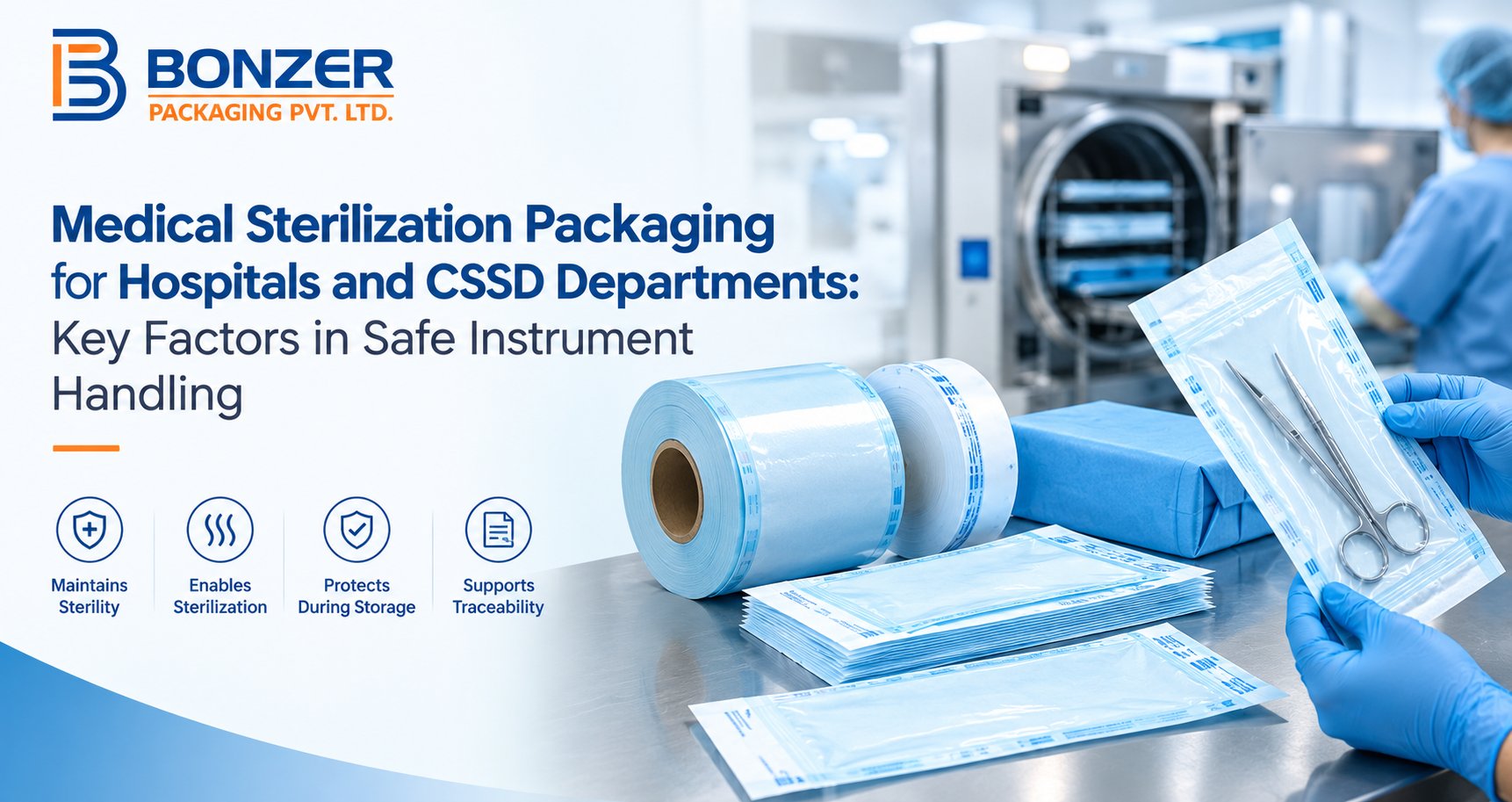
Medical Sterilization Packaging for Hospitals and CSSD Departments: Key Factors in Safe Instrument Handling
Think about everything a surgical instrument goes through before a surgeon picks it up. It's washed, checked, wrapped, sterilized, shelved, and carried across the hospital. If one step goes wrong, the rest of the effort can be wasted. Packaging is often that step, simply because people tend to treat it as routine.
Bonzer Packaging Pvt Ltd provides sterilization packaging to hospitals, surgical centres, pharmaceutical companies, diagnostic laboratories, and medical device manufacturers. In this article, we look at why Medical Sterilization Packaging matters, what Central Sterile Services Department (CSSD) teams should consider when choosing it, and which everyday habits keep instruments safe until the pack is opened.
What Is Medical Sterilization Packaging, and Why Does It Matter?
Medical sterilization packaging covers the pouches, reels, wraps, and similar materials that hold a device during sterilization and protect it afterward. The job sounds simple, but it's really two jobs in one. During the cycle, the packaging has to let the sterilizing agent get to the instrument. Once the cycle is over, it has to act as a sterile barrier through storage, transport, and handling.
When it works properly, good packaging:
● keeps microorganisms and contaminants away from the instruments while the pack stays intact
● lets the chosen sterilizing agent reach the contents, as long as the system is validated for that method
● protects against dust, moisture, and rough handling
● gives you room for labels, batch details, and tracking information
● lets staff open the pack and pass instruments over using proper aseptic technique
Still, packaging doesn't sterilize anything by itself. Patient safety comes from a chain: thorough cleaning, correct preparation, a validated cycle, careful handling, and suitable storage. Take away any one of them and the chain weakens.
The Role of CSSD in Safe Instrument Handling
A CSSD is responsible for reprocessing reusable instruments and equipment. Depending on the hospital, the team may receive used items, clean them, inspect them, assemble sets, pack them, sterilize them, store them, and send them out again. Packaging choices ripple through nearly all of those stages.
Start with inspection. Instruments should be cleaned, dried, checked, and assembled according to your procedures before they go anywhere near a pouch or wrap. Hinged instruments may need to be positioned the way the manufacturer recommends, and delicate ones need protection. And here's the rule that matters most: packaging must never be used to cover up visible soil, leftover moisture, or a defect. If you can see a problem, fix it first.
Then comes the format. A single small instrument may sit comfortably in a pouch, while a heavy set or tray usually calls for a properly sized reel or wrap. Getting this right means less overcrowding, fewer punctures, and less fumbling during preparation and transport.
Finally, there's traceability. Follow your facility's process for recording loads, cycle details, operator information, and identifiers. Labels should stay readable without damaging the sterile barrier. These records make inventory easier to manage, and when a load or pack needs a second look, they're what staff will rely on.
Key Factors to Consider When Choosing Sterile Packaging
There's no single "best" option. The right choice depends on the instrument, the sterilization process, and what happens to the pack after it leaves the sterilizer.
1. Compatibility with the sterilization method
Not every material works with every process, and assuming otherwise is a common mistake. Hospitals should confirm compatibility with their sterilizer, cycle parameters, medical device, and packaging system. The usual methods are:
● Steam sterilization: often used for heat- and moisture-resistant instruments, and the packaging has to allow steam penetration and proper drying.
● Ethylene oxide (EO) sterilization: used for certain heat-sensitive devices, so packaging must allow gas penetration and aeration.
● Hydrogen peroxide plasma or vapour processes: these need compatible materials that let the agent reach the contents.
● Gamma irradiation: used for selected products, mainly in industrial manufacturing, with packaging suited to the radiation process and the product's lifecycle.
Take a Tyvek-based pouch designed for gas or hydrogen peroxide sterilization. It shouldn't be put into a steam cycle just because it looks sturdy. Read the instructions from the packaging, sterilizer, and device manufacturers every time.
2. Barrier performance and material quality
A sterile barrier system has to protect against microbes and also hold up under the stress of sterilization, handling, transport, and storage. Think about resistance to tearing, puncturing, and moisture. Medical-grade paper, polymer films, Tyvek-based materials, crepe paper, and non-woven wraps all have their place. What matters is how the complete packaging system performs for its intended use, not how the material looks or feels.
3. Seal integrity and closure
A seal that's incomplete, contaminated, or damaged defeats the purpose of the pack. For heat-sealed pouches and reels, follow the specified temperature, pressure, dwell time, and equipment instructions, and look over each seal for consistency and visible defects. Self-seal pouches are handy where the design suits the job, but staff need to follow the closure instructions to the letter. If the seal is compromised, the pack isn't an acceptable sterile pack. It's that simple.
4. Size, shape, and instrument configuration
The contents should fit without strain, compression, or lots of dead space. Sharp edges and protruding parts shouldn't press against the material. A heavy surgical set and a small dental instrument call for very different approaches. Oversized packaging is awkward to handle, and an undersized pouch can tear or push against the seals.
5. Identification and process monitoring
Chemical indicators help staff separate processed packs from unprocessed ones and show that a pack was exposed to a particular process. But a colour change alone doesn't prove an item is sterile. Indicators should sit inside a wider quality assurance programme, together with proper labelling, tracking records, and load-release procedures.
6. Storage and transportation
A pack can be processed perfectly and still fail later. Think about the route instruments take between the CSSD, storage areas, operating theatres, and outpatient departments. Keep packs away from moisture, dust, crushing, and unnecessary handling, and inspect each one before it's used.
Common Types of Sterilization Packaging Used in Hospitals
Sterilization pouches and reels are a good fit for individual instruments and smaller sets that stay within the product's size limits. Flat and gusseted formats give you room to match different dimensions. BonzerPackaging Pvt Ltd offers pouches and reels made with medical-grade paper and transparent multilayer film, and the instructions for use should guide choices on cycle compatibility, sealing, and size.
Tyvek-based pouches and reels are used for selected devices and methods, including compatible ethylene oxide and hydrogen peroxide processes. Their strength and tear resistance are real advantages. They aren't right for every method, though, so check compatibility before bringing them into your workflow.
Medical crepe paper is used to wrap compatible instruments and trays. When used according to the manufacturer's instructions and your validated procedures, it can form part of a sterile barrier system. Wrapping technique, material size, and how instruments are arranged all shape the finished pack.
Non-woven wrapping materials such as SMS, SMMS, and SMMMS suit selected instruments and trays. Choose based on construction, intended use, sterilization compatibility, and the barrier performance you need. A heavier material isn't automatically a better one.
Indicator tapes and test packs help monitor exposure to sterilization conditions. Bowie-Dick test products check air removal and steam penetration in pre-vacuum steam systems. They're useful, but they don't replace biological indicators, physical monitoring, equipment maintenance, or other quality assurance measures.
Best Practices for Safe Packaging in CSSD Departments
Most packaging problems come from small habits, not big failures. A few things help:
● Write clear SOPs. Document how you select packaging, prepare instruments, seal, label, inspect, store, and distribute. Train your team, and make it easy for them to flag damaged or doubtful packs.
● Check every pack before use. Look at integrity, identification, and process records. Wet, torn, punctured, opened, or otherwise compromised packs should be handled according to facility policy.
● Don't overload or wrap in a hurry. Stay within the system's stated capacity, arrange instruments properly, and make sure the wrap doesn't block sterilization or make safe opening difficult.
● Review performance regularly. Keep an eye on repeated seal failures, tears, labelling errors, and handling damage. Patterns usually point to something fixable, whether it's materials, training, equipment settings, or storage.
How Bonzer Packaging Pvt Ltd Supports Healthcare Packaging Needs
Bonzer Packaging Pvt Ltd supplies sterilization pouches, flat and gusseted reels, Tyvek-based packaging, medical crepe paper, non-woven wraps, indicator tapes, and indicator strips for healthcare and related industries. Hospital and CSSD procurement teams can compare these options by instrument type, sterilization method, required dimensions, packaging equipment, and handling conditions. Customized sizing is also available for selected products.
Before you place an order, confirm the specifications, intended application, compatibility documentation, and quality requirements for the exact product. That way, the packaging fits neatly into the reprocessing procedures you already have.
Frequently Asked Questions
1. What is the main purpose of medical sterilization packaging?
It holds medical devices during sterilization and helps keep them sterile through storage, transport, and handling until the pack is opened properly.
2. Which packaging is suitable for hospital CSSD departments?
Sterilization pouches, reels, medical crepe paper, and non-woven wraps are all options. The right one depends on the instrument, sterilization method, pack configuration, and manufacturer's instructions.
3. Can the same pouch be used for steam and EO sterilization?
Only if it's specifically designed and validated for both. Check the instructions for use and cycle compatibility first.
4. What should CSSD staff do if a sterile package is damaged?
A torn, punctured, wet, opened, or compromised pack shouldn't be used as a routine sterile item. Follow your facility's procedure for taking it out of use and arranging reprocessing.
5. Does Bonzer Packaging Pvt Ltd offer different packaging sizes?
Yes. Several sizes are listed for selected products, and customized sizes may be available. Confirm the dimensions and specifications for your application.
Conclusion
Safe instrument handling depends on the whole reprocessing pathway: cleaning and inspection, validated sterilization, secure packaging, careful storage, and aseptic presentation. The right packaging helps CSSD departments protect sterile instruments, work more consistently, and cut down package-related failures. As you compare options, focus on sterilization compatibility, dependable barrier performance, seal integrity, correct sizing, traceability, and how easy the pack is to handle day to day.
Is your CSSD getting the most out of its packaging process? Contact Bonzer Packaging Pvt Ltd and share your instrument types and sterilization method. Our team will help you shortlist the right pouches, reels, and wraps for your department's workflow.