
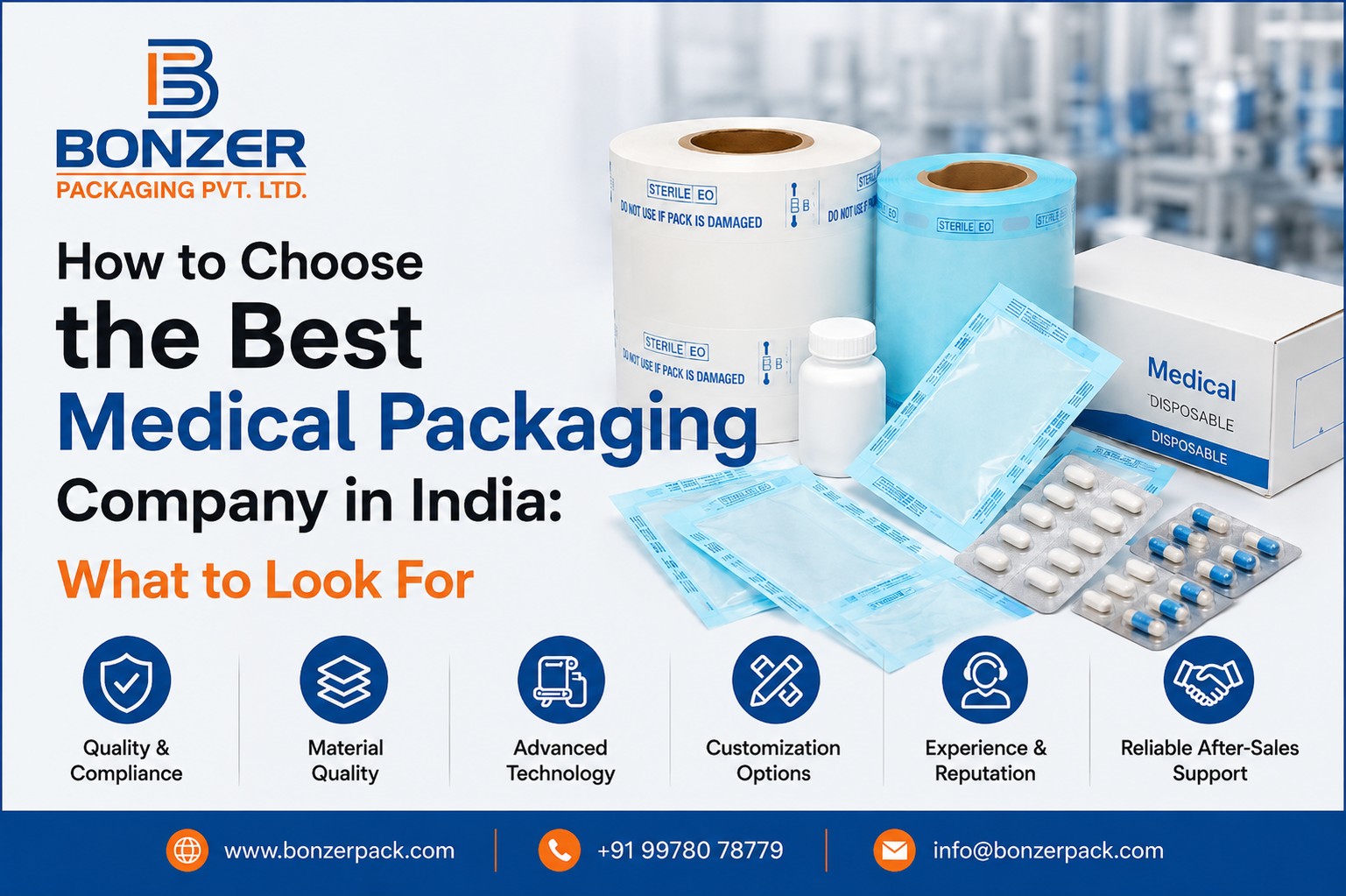
How to Choose the Best Medical Packaging Company in India: What to Look For
When the product inside the package is used in a hospital, laboratory, pharmaceutical facility, or medical device manufacturing unit, packaging is far more than an outer layer of protection. It can directly affect sterility, product integrity, storage life, handling, and patient safety.
That is why choosing the right Medical packaging company in India requires more than comparing prices or product photographs. You need a supplier that understands sterilization requirements, material performance, sealing, quality control, consistency, and the practical demands of healthcare packaging.
So, how do you know whether a packaging manufacturer is genuinely suitable for your requirements?
Here are the key factors to evaluate before making a decision.
What Should You Expect from a Medical Packaging Company in India?
A reliable medical packaging supplier should be able to demonstrate more than manufacturing capacity. The right partner should understand how packaging performs throughout the product's journey, from filling or instrument preparation to sterilization, storage, transportation, and final use.
For terminally sterilized medical devices, ISO 11607-1:2019 specifies requirements and test methods for packaging materials, sterile barrier systems, and packaging systems intended to maintain sterility until the point of use. ISO 11607-2:2019 addresses validation requirements for forming, sealing, and assembly processes.
When evaluating a supplier, look for:
● Appropriate medical-grade packaging materials
● Compatibility with the intended sterilization method
● Consistent seal and package performance
● Defined quality-control procedures
● Testing and inspection processes
● Product traceability
● Customization capabilities
● Reliable production and supply capacity
● Technical support when selecting packaging
A supplier that can address these areas is more likely to be a long-term packaging partner rather than simply a product vendor.
1. Check the Quality of Materials and Manufacturing
The material used in medical packaging directly affects its barrier properties, strength, flexibility, transparency, and ability to withstand sterilization and handling.
Depending on the application, medical packaging may involve medical-grade paper, multilayer films, Tyvek-based materials, aluminium foil structures, or other specialized combinations.
Before choosing a manufacturer, ask:
- What raw materials are used?
- How are incoming materials inspected?
- Are production conditions controlled?
- How is product consistency maintained between batches?
- What quality checks are performed before dispatch?
For example, a sterilization pouch may look perfectly acceptable but still have problems with seal strength, channel leaks, material defects, or inconsistent dimensions. These issues can become significant when packaging must protect a sterile product through transportation and storage.
A good manufacturer should therefore have documented processes for raw-material inspection, production control, testing, and final inspection.
2. Make Sure the Packaging Matches Your Sterilization Process
Not every medical package is suitable for every sterilization method.
Your packaging selection should be based on the product, sterilization process, package configuration, and required barrier performance.
Common requirements may involve:
● Steam sterilization
● Ethylene oxide (EO/ETO) sterilization
● Other validated sterilization processes
● Different instrument sizes and configurations
● Different storage and transportation conditions
This is where technical knowledge matters.
A capable Medical packaging company in India should help you identify whether a flat pouch, gusseted pouch, sterilization reel, self-seal pouch, Tyvek-based solution, aluminium foil pouch, or another packaging format is appropriate for your application.
The goal is not simply to select the cheapest package. The goal is to select a package that performs reliably through the complete sterilization and handling process.
3. Evaluate Sterile Barrier and Seal Integrity
One of the most important questions to ask is simple:
Will the packaging continue to protect the product after sterilization?
A sterile barrier system needs to maintain its intended performance until the product reaches the point of use. Packaging performance can be affected by material selection, sealing conditions, package design, transportation, storage, and handling.
ISO 11607-1 specifically addresses packaging systems intended to maintain sterility of terminally sterilized medical devices until the point of use.
Look for a supplier that pays close attention to:
● Seal consistency
● Seal strength
● Package dimensions
● Material integrity
● Puncture and tear resistance
● Opening characteristics
● Barrier performance
● Package compatibility with sterilization
If your packaging is heat sealed, sealing parameters and process validation become especially important. ISO 11607-2 covers validation requirements for forming, sealing, and assembly processes.
4. Look Beyond Certifications: Examine the Quality System
Certifications can be useful, but simply displaying a logo on a website should not be the end of your evaluation.
Ask what the quality system actually looks like.
For medical-device-related manufacturing, ISO 13485:2016 is an internationally recognized quality management standard specifically designed around medical devices and related regulatory requirements. ISO explains that it provides a framework for consistent design, production, and delivery while addressing regulatory requirements and risk management.
When evaluating suppliers, look for evidence of:
● Documented quality procedures
● Batch or lot traceability
● Incoming material inspection
● In-process quality checks
● Final product inspection
● Complaint handling
● Corrective and preventive action processes
● Controlled documentation
This distinction matters because a certificate tells you a system exists; the manufacturer's processes tell you how that system is actually being applied.
5. Consider Product Range and Customization
Your packaging requirements may change as your product portfolio grows.
A supplier offering only one standard pouch size may not be the best long-term choice if you need multiple formats later.
Look for manufacturers offering a useful range of Medical Sterilization Packaging, such as:
● Flat sterilization pouches
● Gusseted sterilization pouches
● Sterilization reels
● Self-seal pouches
● Tyvek-based sterilization packaging
● Aluminium foil pouches
● Medical wrapping materials
● Chemical indicator-related products
● Other sterile barrier and packaging accessories
Bonzer Packaging Pvt. Ltd., for example, offers sterilization flat and gusseted reels, flat and gusseted pouches, self-seal pouches, Tyvek/film products, aluminium and aluminium foil pouches, medical crepe wrapping sheets, and sterilization indicators.
Customization is also worth discussing. Depending on the application, you may require specific dimensions, material combinations, printing, pack configurations, or packaging formats.
6. Assess Manufacturing Controls and Testing
The best medical packaging manufacturers in India do not rely solely on visual inspection.
A stronger evaluation considers how the manufacturer controls production and verifies product consistency.
Ask whether the company has:
● Controlled manufacturing areas
● Defined production procedures
● Raw-material inspection
● First-article or sample evaluation
● Seal testing
● Dimensional checks
● Batch-level inspection
● Traceability systems
● Documented testing procedures
Bonzer Packaging Pvt Ltd, for instance, states that its manufacturing operation includes a Class 100,000-grade clean workshop, incoming quality inspection, and first-article inspection processes.
These details are useful because they show how a supplier approaches consistency rather than simply telling you that quality is important.
7. Compare Total Value, Not Just the Per-Piece Price
Price is important, especially for hospitals, distributors, and manufacturers working with large volumes. But the lowest quotation is not automatically the lowest-cost option.
Consider the total cost of packaging.
A cheaper package can become expensive if it results in:
● Damaged products
● Seal failures
● Material wastage
● Inconsistent dimensions
● Production interruptions
● Emergency reorders
● Delayed deliveries
● Higher rejection rates
Instead, compare suppliers based on:
Material quality + consistency + testing + delivery reliability + technical support + total cost.
For example, an Ahmedabad-based medical device manufacturer may initially compare two suppliers purely on pouch pricing. But if one supplier provides consistent dimensions, reliable delivery, better technical support, and fewer rejected batches, the slightly higher unit price may produce a lower overall operating cost.
That is the kind of comparison procurement teams should make.
8. Check Supply Reliability and Scalability
A supplier may perform well for a small trial order but struggle when your monthly requirement increases.
Before committing, discuss:
● Minimum order quantities
● Standard lead times
● Production capacity
● Stock availability
● Repeat-order timelines
● Emergency requirements
● Packaging and dispatch procedures
● Ability to scale with your business
This is particularly important for hospitals, medical distributors, and manufacturers with recurring demand.
A good supplier should be able to support both your current requirements and reasonable future growth.
9. Choose a Supplier That Understands Your Application
The best packaging is not necessarily the most advanced packaging. It is the packaging that fits your product and process.
For example, a hospital CSSD may prioritize convenient sterilization reels and pouches, while a medical device manufacturer may need customized sterile barrier packaging with greater emphasis on process validation and repeatability.
A pharmaceutical or healthcare company may have different barrier, moisture, light, or protection requirements.
Before requesting a quotation, prepare basic information such as:
● Product or instrument type
● Product dimensions
● Sterilization method
● Required package format
● Expected order volume
● Storage conditions
● Transportation requirements
● Desired customization
The more information you provide, the easier it becomes for the manufacturer to recommend an appropriate solution.
A Simple Checklist Before Selecting Your Supplier
Before finalizing a medical packaging supplier, ask these questions:
Quality
● Does the supplier use suitable medical-grade materials?
● Are incoming and finished products inspected?
● Can the supplier explain its quality-control process?
Packaging performance
● Is the packaging suitable for your sterilization method?
● Are sealing and barrier performance addressed?
● Can the supplier provide relevant technical information?
Manufacturing
● Does the manufacturer have controlled production processes?
● Can it maintain consistent quality across batches?
● Can it handle your expected volumes?
Customization
● Are different sizes and configurations available?
● Can the packaging be customized for your application?
Supply
● Are lead times realistic?
● Can the company support repeat orders?
● Can production scale as your requirements grow?
Support
● Does the supplier understand medical packaging applications?
● Can its team help with material and format selection?
If a manufacturer can confidently answer these questions, you have a much stronger basis for making your decision.
Why the Right Medical Packaging Partner Matters
Medical packaging is part of the overall product protection system. The wrong material, poor sealing process, inconsistent production, or unreliable supply can create problems far beyond packaging costs.
The right supplier brings together material expertise, manufacturing discipline, testing, consistency, customization, and dependable service.
That is why companies should evaluate packaging manufacturers as long-term technical partners rather than simply comparing quotations.
For healthcare organizations and medical manufacturers in Ahmedabad and across India Bonzer Packaging Pvt. Ltd. provides a range of Medical Sterilization Packaging products designed for hospitals and pharmaceutical and healthcare applications. Its product portfolio includes sterilization pouches, reels, Tyvek/film solutions, aluminium foil pouches, wrapping sheets, and sterilization indicators.
Choosing the right packaging partner ultimately comes down to one question: Can this supplier consistently deliver packaging that protects my product, supports my sterilization process, meets my quality expectations, and remains reliable as my requirements grow?
If the answer is yes, you are not simply buying packaging. You are building a more dependable part of your medical supply chain.
Frequently Asked Questions
What is a medical packaging company in India?
A medical packaging company manufactures or supplies packaging designed for medical, healthcare, pharmaceutical, or sterilization applications. The right supplier should understand material performance, sterilization compatibility, sealing, quality control, and sterile barrier requirements.
How do I choose the best medical packaging manufacturer?
Compare manufacturers based on material quality, manufacturing controls, testing, sterilization compatibility, customization, certifications, supply reliability, and technical support rather than price alone.
Why is Medical Sterilization Packaging important?
Medical Sterilization Packaging is designed to help protect medical products and devices during sterilization, storage, transportation, and handling. Its suitability depends on the product, sterilization method, and required barrier performance.
What should I check before buying sterilization pouches?
Check the pouch material, dimensions, seal performance, sterilization compatibility, barrier properties, opening characteristics, quality controls, and suitability for your specific medical application.
Is customization important for medical packaging?
Yes. Custom sizes, materials, formats, and configurations can help ensure that packaging is properly suited to the product, sterilization process, storage requirements, and handling conditions.
What standards should medical packaging suppliers understand?
ISO 11607 is particularly relevant to packaging for terminally sterilized medical devices, while ISO 13485 relates to quality management systems for medical devices. The applicable requirements depend on the product and intended use.
Is it worth choosing a local medical packaging manufacturer?
A local or India-based supplier can offer practical advantages such as easier communication, shorter logistics routes, faster sampling, and potentially more responsive support. The final decision should still be based on quality, capability, compliance, and supply reliability.